


Flag Football Playmaker X
True Partners, LLC
Designing a flag football playbook sounds simple until the team has several formations, changing player roles, and a game-day wristband that must make sense at a glance. Flag Football Playmaker X is built for that specific problem. I found it most useful as a focused sports app for turning plays into something a coach can organize, print, and share with players, rather than as a general coaching platform.
The app comes from True Partners, LLC, and it is free to install, with optional in-app purchases priced from $7.99 to $12.99 per item. It is rated for Everyone, runs on operating systems from version 9 onward, and its current version is 1.10.0. Those details make it approachable for a youth coach, recreational league organizer, or parent who needs a practical playbook without committing to a large coaching system.
Where the real friction begins
My first impression is that the value is not in opening the app and drawing one clever play. The value appears when I use it as part of a repeatable preparation routine: create a play, check that the diagram is readable, arrange the material into a playbook, and then prepare a wristband reference that players can actually use under pressure.
That workflow also explains where users may get stuck. A coach who expects a fully automatic play-calling system may find the experience narrower than expected. This is primarily a design and printing tool for flag football material. It helps organize the information, but it does not replace the coaching decisions behind route spacing, timing, motion, defensive adjustments, or player teaching.
The first important distinction is between making a diagram and making a usable play. A diagram can look tidy on a phone while still being too crowded when printed or reduced for a wristband. I recommend treating every play as a communication tool: use short names, keep routes visually distinct, and avoid adding details that players do not need during a live snap.
Related News

Why WhatsApp Messenger Still Makes Everyday Communication Feel Easy

Jurassic World: The Game Is the Better Dino Tycoon for Strategic Players

Threads in Real Life: Who Should Join, Lurk, or Leave

How SHEIN Turned Shopping Into an Endless Content Feed

How to Make Fortnite Feel Smarter on Mobile

Should You Switch to Microsoft Outlook on Mobile?
This matters especially for younger teams. A coach may understand a diagram with several arrows and labels, but a player who is checking a wristband quickly needs a much simpler visual language. The app can support the preparation of that material, but the coach still has to decide what belongs in the final version.
Another likely sticking point is expecting the playbook and wristband to be identical. They serve different purposes. The playbook can explain the complete idea, including alignment and responsibilities. The wristband should be a compact calling aid. I get better results when I prepare the detailed playbook first, then create a simplified game-day reference from it instead of trying to make one layout serve both jobs.
Start with a small test instead of a full season
Before entering an entire offensive system, I would create a small sample set covering different situations: a basic run, a short passing concept, a play with motion, and a play that requires a clear protection or timing reminder. This exposes layout problems early and shows whether the naming system is understandable to someone who did not create the diagram.
Gallery
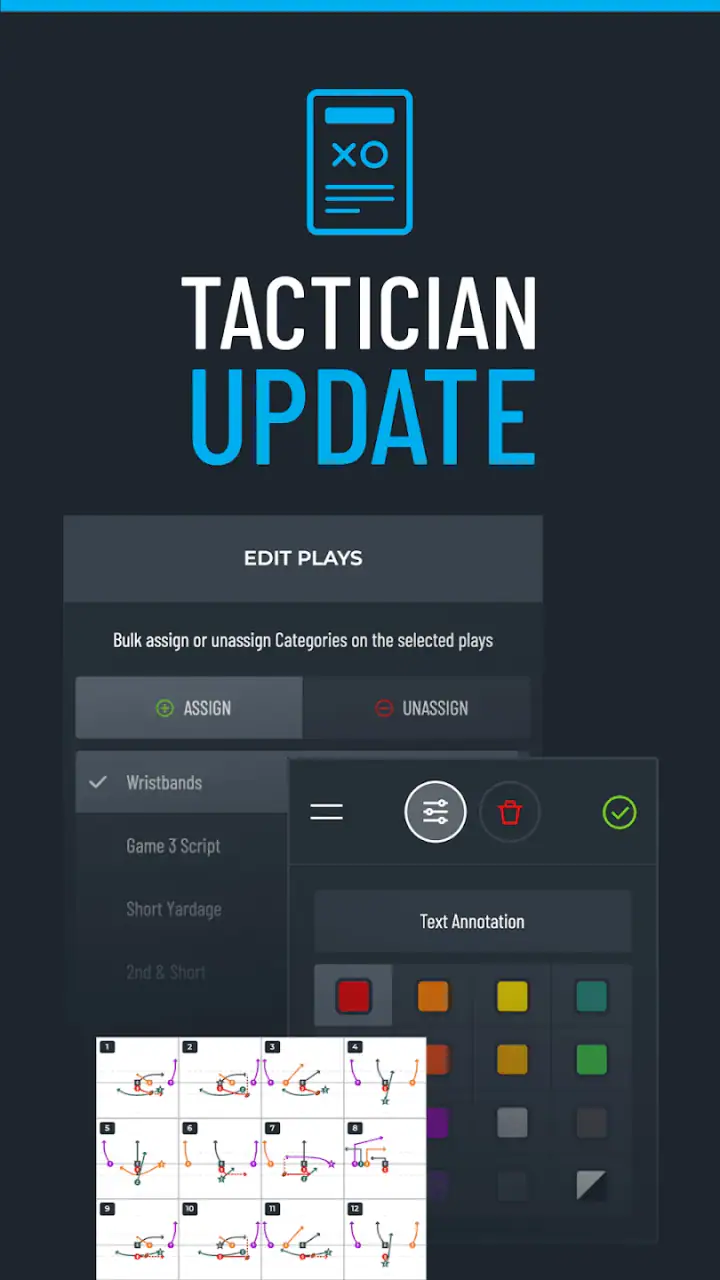
That test also answers a practical question: does the app fit the way your team thinks? Some coaches organize by formation, while others group plays by situation or player assignment. If the structure feels natural with a few plays, expanding it is sensible. If the sample already feels difficult to navigate, adding dozens more will only make game-day use harder.
I would also ask another coach or an experienced player to read the sample without verbal help. If they need the creator to explain every symbol, the problem is not necessarily the software. It may be that the play has too much information or that the team needs a shared set of naming conventions.
Setup checks that prevent avoidable problems
Because the app is intended to support playbook design and printing, setup should be treated as part of the coaching workflow rather than an afterthought. I would begin by deciding the final destination for each piece of content. A page in the playbook can carry teaching detail, while a wristband entry needs fast recognition. That decision affects labels, spacing, and how much text belongs on each design.
Use consistent terminology from the beginning. If one play calls a position “X” and another uses a full player name for the same role, confusion can appear later when the material is printed. The app can organize your designs, but it cannot resolve inconsistent football language. A simple team glossary written before data entry saves more time than correcting every play individually.
Names should also be short enough to work in a huddle. I prefer a naming pattern that tells players the formation and concept without becoming a sentence. When a wristband is involved, long names create a practical delay: players spend time searching for the call instead of preparing for the snap.
Before printing, inspect the design at the size players will actually see. A line that looks obvious on a phone may become difficult to distinguish on paper. This is one of the most useful checks for the app’s intended purpose. I would print one representative page and one representative wristband section before preparing the whole set.
Printing quality can also depend on factors outside the app, such as the selected printer, paper, scaling settings, and the device’s print path. If the output looks cropped or unexpectedly small, I would first check whether the print dialog is scaling the page or fitting it to a different paper size. That is a safer first step than rebuilding every play.
The same principle applies to text that appears cut off. Check the preview, orientation, margins, and paper selection before assuming the design itself is broken. A preview that already shows clipping points to a layout issue; a clean preview followed by a poor physical print points more strongly to the printing route.
Prepare for the device you will actually use
The minimum operating-system requirement is version 9, which gives the app a relatively broad compatibility range. Even so, compatibility is not the same as convenience. A larger screen can make diagram editing easier, while a phone may be more convenient beside the field. I would do the main design work on the device that gives me enough room to distinguish routes and labels, then use the printed result for game day.
Do not wait until the night before a tournament to discover that the chosen output is inconvenient. Build a sample, print it, fold or place it in the intended wristband, and ask a player to find a call quickly. This physical test reveals issues that are easy to miss while working digitally, including cramped text, ambiguous symbols, and an ordering system that makes sense only to the coach.
Since optional purchases are available, I would begin with the free installation and confirm that the basic workflow matches the team’s needs before paying for anything. The listed purchase range is not a reason to avoid the app, but it is a reason to identify exactly which part of the workflow requires an upgrade. A coach who only needs a small personal playbook may have a different threshold from a league preparing materials for many players.
Recovering when a workflow goes wrong
The best recovery method is to isolate the stage that failed. If the play is confusing before printing, simplify the play or its labels. If it looks right in the app but not on paper, inspect the preview and print settings. If the printed material is clear but players still hesitate, the issue is probably teaching, naming, or the order in which calls are presented.
I would avoid changing several things at once. For example, if a printed wristband is difficult to read, do not simultaneously rename every play, change the diagram style, and alter the paper format. Make one small adjustment, test it, and keep the version that improves recognition. This creates a reliable troubleshooting trail and prevents the team from learning multiple layouts for the same concept.
A useful recovery workflow is to keep a “practice” set separate from the “game” set. New designs can be tested without disrupting the material players already know. Once a play has been taught and used successfully, move it into the game-ready group. This separation is particularly helpful when a coach experiments with variations but wants the wristband to remain stable.
When a play needs revision, preserve the original idea in the name or notes rather than silently replacing it. A small change to a route or assignment can create uncertainty if players have memorized the earlier version. Clear version labels are more valuable than clever organization because they help the coach explain exactly what changed.
If a player cannot find a call, reduce the number of choices visible at once. A wristband is not improved by containing every possible play. Grouping calls by formation, color, number, or situation can work, but the team must use one method consistently. I would choose the method players can recall without coaching prompts, even if it looks less sophisticated on paper.
Use the playbook as a teaching document
The strongest use of the app is not simply printing attractive diagrams. It is creating a shared reference that lets the team discuss the same play away from the field. For each design, I would decide what players must know before practice: starting alignment, first movement, primary read, and what to do if the defense removes the first option.
That does not mean filling every page with explanations. A crowded playbook can be as unhelpful as an empty one. The detailed version should answer teaching questions, while the wristband version should answer the immediate question, “What is my assignment when this call comes in?” Keeping those purposes separate is a practical advantage of using a dedicated playbook tool rather than a general drawing application.
One non-obvious benefit of this approach is that it exposes gaps in the offensive system. If a play cannot be reduced to a clear call and individual responsibilities, it may not yet be ready for competition. The design process becomes a coaching test: unclear diagrams often point to unclear instructions on the field.
When the app is not the cause
It is easy to blame the app when a team struggles, but many problems happen after the design stage. Players may know the diagram but not recognize the formation quickly. They may understand their route but not the timing. They may find the wristband entry but hesitate because the team has not practiced the call under realistic pressure.
I would test the complete chain: call the play verbally, let the player locate it, allow the formation to settle, and then run it. If the breakdown occurs before the snap, focus on naming and organization. If it occurs during the play, focus on coaching and repetition. The app can make the reference clearer, but it cannot create shared timing by itself.
There is also a risk of overbuilding. A coach who enjoys designing plays may create more options than a team can remember. In my experience, a smaller collection of well-taught calls is more useful than a large library that players rarely practice. The app makes it easier to prepare material, so discipline is needed to prevent preparation from becoming clutter.
This is also where the usual alternatives may be better for some users. A notebook is faster for a coach who wants to sketch one idea during practice. A general drawing app may suit someone who needs complete visual freedom. A spreadsheet or document can be enough for a very small team that only needs text-based assignments. Those options may be cheaper or more flexible for isolated tasks, but they do not focus as directly on the combination of flag football diagrams, playbook organization, and wristband preparation.
On the other hand, a larger coaching platform may be preferable for a club that needs extensive team administration, video analysis, opponent scouting, or shared coaching access. Flag Football Playmaker X makes more sense when the central need is a practical play-design and printing workflow, not an all-in-one sports management system.
Who will get the most from it?
I think the app is a good fit for volunteer coaches, youth teams, recreational leagues, and anyone moving from handwritten diagrams to a repeatable digital process. It is especially helpful when several people need to refer to the same terminology or when a coach wants a printed playbook that looks consistent across practices.
It is less suitable for a player who only wants drills, scores, live match information, or fitness tracking. It is also not the first tool I would choose for someone who wants to invent plays casually without printing or organizing them. The app’s purpose is specific, and that specificity is its strength only when it matches the job.
The audience signal is encouraging without being overwhelming: the app has passed fifty thousand installs and holds a 4.4 average from 261 ratings, with 64 written reviews. I read that as evidence of a real niche audience rather than proof that it will suit every football setup. The free price makes trying it low-risk, while the optional purchases mean teams should evaluate their actual printing needs before expanding their use.
My practical verdict after using the workflow
Flag Football Playmaker X is most convincing when I treat it as a bridge between coaching ideas and usable field material. It helps turn a collection of plays into something that can be reviewed, printed, and adapted for a wristband. That is more focused than a blank drawing tool and less ambitious than a complete team-management suite.
The main lesson is to test the complete output, not just the design screen. Create a small set, check the terminology, inspect the print preview, print a sample, place it where players will use it, and run the calls in practice. This process catches the problems that matter most: unreadable diagrams, confusing names, excessive choices, and a mismatch between the detailed playbook and the quick-reference wristband.
There is still work for the coach. The app does not decide which concepts belong in the offense, how many calls players can handle, or how assignments should change against different defenses. It also cannot fix a printer setting, a rushed practice, or inconsistent team language. But those limits are reasonable for a focused sports app, and understanding them prevents disappointment.
For me, the strongest recommendation is for a coach who wants structure without adopting a heavyweight coaching ecosystem. Start free, build a small test playbook, and pay only if the extended workflow proves useful for your team. If your goal is simply to sketch ideas, a notebook may be quicker. If your goal is to prepare clear flag football material that can move from design to print to wristband, this app is worth a serious trial.
FAQs for Flag Football Playmaker X
What is Flag Football Playmaker X used for?
Flag Football Playmaker X is designed to help coaches, players, and teams create, organize, and review flag football plays. After exploring its tools, the app appears especially useful for drawing formations, assigning player routes, explaining offensive or defensive concepts, and keeping a digital playbook available during practices or games. It can reduce the need for paper diagrams and make play communication more consistent across the team.
Is Flag Football Playmaker X suitable for beginners or only experienced coaches?
The app can be useful for both beginners and experienced coaches, although new users may need a little time to understand the play-design interface and available options. Beginners can use it to learn basic formations, routes, and responsibilities visually, while experienced coaches may appreciate the faster way to build and adjust a larger playbook. Its usefulness depends on how detailed and organized your team’s strategy is.
Can I create and customize my own flag football plays?
Yes, the main attraction of Flag Football Playmaker X is the ability to create customized plays rather than relying only on preset examples. You can generally arrange players, select formations, draw routes, and add instructions that match your team’s style. This makes the app practical for coaches who want to adapt plays to different player abilities, opponents, field conditions, or specific game situations.
Does Flag Football Playmaker X work without an internet connection?
Offline availability may depend on the specific version of the app and which features you are using. Basic play design and previously saved content may be accessible without a constant connection, but features such as synchronization, sharing, updates, or online storage could require internet access. Before relying on it during a game or practice, open your saved playbook in advance and confirm that the required tools work offline.
Is Flag Football Playmaker X free to download, and are there in-app purchases?
The download price and available in-app purchases can vary between the Android and iOS versions, as well as by region and developer updates. Some features may be available at no cost, while advanced tools, additional playbook capacity, exports, or other options could require payment. It is worth checking the current store listing carefully before downloading, including subscriptions, one-time purchases, and any limitations of the free version.
Pros
- Designed specifically for flag football play design and strategy.
- Helps organize plays into a reusable digital playbook.
- Useful for coaches planning practices and game situations.
- Visual play diagrams can make assignments easier to explain.
- Supports quicker adjustments than drawing plays on paper.
Cons
- May feel complicated for beginners unfamiliar with play-design tools.
- Creating detailed formations can take time on a phone screen.
- Best value depends on having a clear coaching system already.
- Small displays may make crowded play diagrams harder to read.
- Some advanced features may require in-app purchases or subscriptions.


